Findings allow scientists to learn more about dark matter’s influence on stars, galaxies, and planets

Dense regions of dark matter are connected by lower-density filaments, forming a weblike structure known as the cosmic web. This pattern appears more clearly in the
Webb data than in the earlier Hubble image. Ordinary matter, including galaxies, tends to trace this same underlying structure shaped by dark matter. (NASA/STScI/A. Pagan)
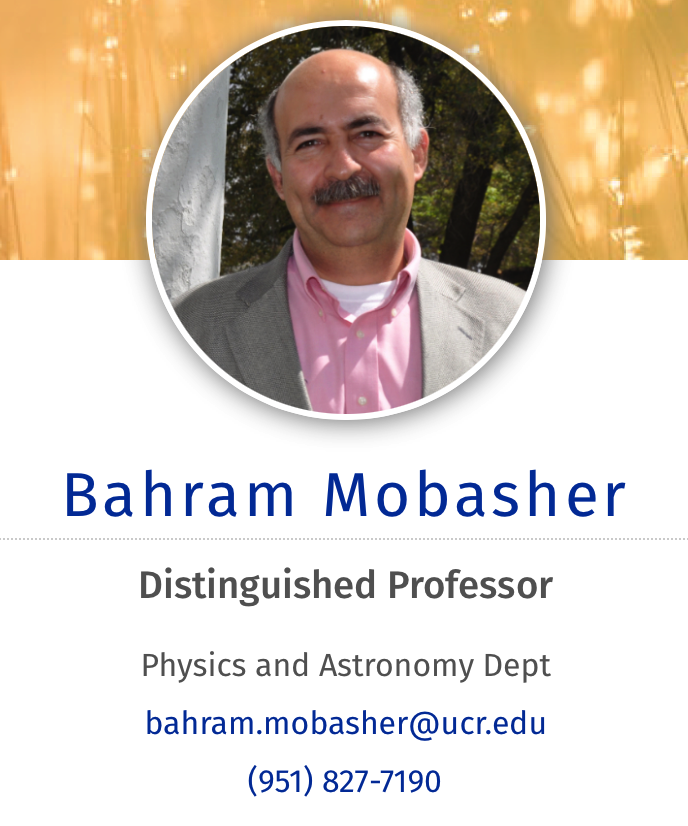
Using data from NASA’s James Webb Space Telescope (JWST), scientists, including astronomer Bahram Mobasher at UC Riverside, have made one of the most detailed, high-resolution maps of dark matter distribution ever produced. It shows how the invisible, ghostly material overlaps and intertwines with “regular” matter, the stuff that makes up stars, galaxies, and everything we can see.
Published today in Nature Astronomy, the map builds on previous research to provide additional confirmation and new details about how dark matter has shaped the universe on the largest scales — keeping together galaxy clusters millions of light-years across or governing the formation of individual galaxies.
As a founding member of the Cosmic Evolution Survey (COSMOS) project, Mobasher helped establish one of the first detailed dark matter maps with the Hubble Space Telescope in 2007. The new Webb map builds directly on that earlier work and benefits from Webb’s far superior resolution and depth, allowing scientists to see the cosmic web of dark matter with unprecedented clarity.
Mobasher’s expertise was crucial in interpreting the COSMOS field, a region of sky about 2.5 times the size of the full Moon that has been observed by at least 15 telescopes worldwide. The data he and his colleagues helped gather provided the foundation for comparing the distribution of regular, luminous matter with the newly inferred distribution of dark matter. This comparison is vital for understanding how dark matter’s gravitational influence shaped large-scale cosmic structures like galaxy clusters, filaments, and voids.
Click Here for More Information.
 About UC Riverside
The University of California, Riverside is a doctoral research university, a living laboratory for groundbreaking exploration of issues critical to Inland Southern California, the state and communities around the world. Reflecting California’s diverse culture, UCR’s enrollment is more than 26,000 students. The campus opened a medical school in 2013 and has reached the heart of the Coachella Valley by way of the UCR Palm Desert Center. The campus has an annual impact of more than $2.7 billion on the U.S. economy. To learn more, visit www.ucr.edu.
Share this:

Discover more from Fullerton Observer
Subscribe to get the latest posts sent to your email.
Categories: Education, Local News, Regional