

Nuclear waste storage canister (courtesy of Southern California Edison, SONGS Community website)
The recent chemical plant emergency in Garden Grove should be a wake-up call for all of Southern California, home to the de facto nuclear waste dump site at San Onofre, just south of San Clemente.
In Garden Grove, the threat from a tank holding roughly 7,000 gallons of a common hazardous industrial liquid — about one-third the volume of a typical backyard swimming pool — was enough to force the evacuation of a reported 50,000 residents, close schools and roads, open emergency shelters, and mobilize a massive public-safety response.
Families had to leave their homes. Businesses were disrupted. Residents waited days for updates from public agencies and company officials, fearing the overheating and bulging tank would rupture and spill its contents or even explode.
This incident drives home an important lesson: When hazardous material is stored near homes, schools, businesses, and major roads, the danger does not have to be enormous in size to become enormous in consequence. The material stored in the tank was methyl methacrylate — a chemical used in plastic products that is also an eye, skin and mucous membrane irritant in humans. The possibility that the tank could leak its contents into adjacent neighborhoods or, worse yet, explode, was deemed enough of a public threat to trigger immediate evacuation.
Another lesson is the stark reminder that unexpected industrial accidents are a reality of our industrialized modern world, regardless of whether they result from industry failures or inadequate regulatory oversight. Simply put, dealing with dangerous substances carries inherent risks, and putting public safety first means taking as many precautionary measures as possible.
These lessons should lead us directly to San Onofre, where highly radioactive nuclear waste is stored. This nuclear waste is so deadly that it must be securely isolated away from humans and the environment for a million years. Consequently, it’s conceivable that a major leak or explosion of storage canisters at San Onofre could render Southern California uninhabitable for untold future generations.

San Onofre is situated within 50 miles of 8 million people, sandwiched between the ocean and the I-5 Freeway.
The San Onofre Nuclear Generating Station was shut down in 2013. However, the 3.6 million pounds of highly radioactive spent nuclear fuel remain on site for the foreseeable future because there has been no progress toward creating a permanent national repository for commercial nuclear waste. Compounding the problem, efforts to persuade states such as Texas and New Mexico to store nuclear waste from other states on an interim basis have so far fallen flat.
The nuclear waste storage configuration adopted at San Onofre is arguably the least safe in the nation. The spent nuclear fuel sits outside, next to the shore, in 123 thin-walled (5/8 inch) and aging steel canisters roughly 20 feet tall. The moist, salty air encourages canister corrosion. Narrowly sandwiched between the Pacific Ocean and Interstate 5, the location is vulnerable to earthquakes, tsunamis, storm flooding, sea-level rise and terrorist attacks.
Each canister holds roughly one-third the amount of highly radioactive Cesium-137 that was released at the 2011 Fukushima nuclear disaster. This situation at San Onofre is not a distant problem. It is not merely a technical issue for federal regulators to address. It is a Southern California public-safety issue.
The comparison with Garden Grove is not perfect. A tank containing a common industrial chemical in Garden Grove and canisters storing highly radioactive nuclear waste at San Onofre pose far different threats. However, the public-safety principle at issue is the same: Dangerous materials must be stored in the safest possible configuration before a crisis occurs, not after.
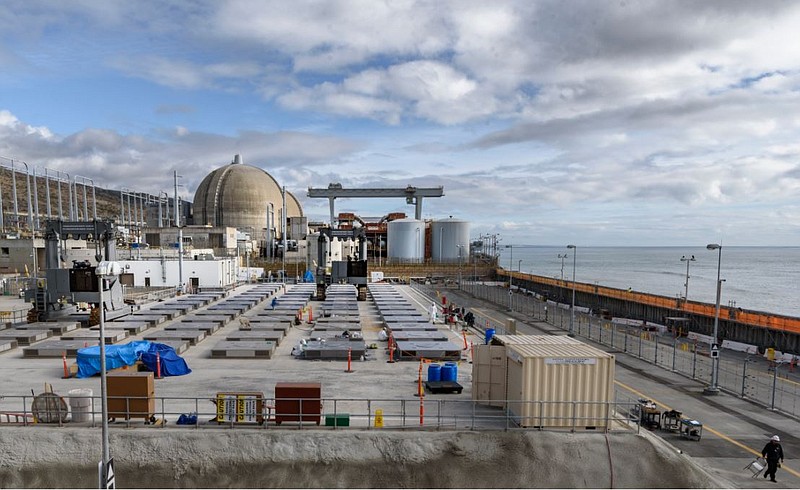
The site of spent nuclear fuel storage at the San Onofre nuclear power plant is shown in this photo from January 2018.
At San Onofre, the question is not whether government or industry officials can reassure us that the nuclear waste is securely stored for today. The question is whether the current storage arrangement is certain to protect the public for the next several decades.
There is no guarantee that the federal government will deliver on its responsibility to provide a permanent repository for commercial nuclear waste soon enough for Southern California. That means that the stranded nuclear waste at San Onofre is not only a federal issue, but it is also a California public-safety problem. Local and regional leaders must not wait passively for Washington to solve it.
Southern California needs its own safety plan for San Onofre now. That plan should better secure the nuclear waste going forward, including the construction of an above-ground fortified storage facility designed for long-term monitoring, emergency protection, and resilience against flooding, earthquakes, tsunamis, fire, and security threats. It should include clear public reporting on inspections, canister integrity, emergency response planning, and options for repackaging or relocating the nuclear waste if needed.
This is not about panic. It is about our responsibility to avert a possible disaster — a disaster that could render much of Orange County and Southern California uninhabitable.
Garden Grove reminds us of the importance of taking every precautionary measure when dealing with inherently dangerous chemicals. San Onofre is our opportunity to act locally before the emergency sirens sound.
———————————–
“The author, Sarah Mosko, thanks Irvine Mayor Larry Agran and Chief Policy Advisor Scotty Hong for their contributions and assistance in developing this article.
Share this:

Discover more from Fullerton Observer
Subscribe to get the latest posts sent to your email.
Categories: Education, Health, Local News


