
Fred Jung ran for Orange County Supervisor in 2026 with nearly every institutional advantage a local politician could assemble.
He ran as the sitting mayor of Fullerton, a title he has monopolized for four of the last six years. He has been appointed to influential regional bodies dealing with transportation, water, and energy. His campaign for Supervisor reported raising more than $350,000 during 2025, including nearly $200,000 transferred from his City Council campaign account, according to a Fullerton Observer review of campaign filings.
Jung had money, titles, coveted regional appointments, influential relationships, and the visibility that comes from repeatedly serving as mayor of one of Orange County’s largest cities.
What he did not have was broad public support in his district, in Fullerton or beyond.
For the first time since 2003, the Fourth District’s Supervisor will not be from Fullerton. Jung finished last out of four candidates in the June 2026 primary for Orange County’s Fourth Supervisorial District. According to the Orange County Registrar of Voters’ final Statement of Vote, Jung received 19,955 votes, or just 17.6%. Connor Traut finished first with 37,726 votes, followed by Tim Shaw with 35,446 and Rose Espinoza with 20,258.
This was not a close loss. Nor can it be explained simply by Jung being unknown outside Fullerton. He ran with numerous county-level municipal appointments and has spent years cultivating his profile throughout Orange County.
But I wanted to know something more specific than these county-level numbers: Does Fred Jung have broad support in Fullerton and in his own council district, District 1 (D1)? Jung received 72.1% of the vote in D1 when he ran for reelection to the City Council in 2024. Although that two-candidate general election is not directly comparable to a four-candidate primary for a different office, such a strong showing suggests a substantial political base in District 1. And after repeatedly serving as mayor, Jung might reasonably have been expected to enjoy a meaningful home-city advantage across Fullerton. The Supervisor’s race results provide an opportunity to explore how far that support actually extended.
To answer these questions, I analyzed the Registrar’s election results for Fullerton, including the totals reported for each of the city’s five council districts. The results are striking:
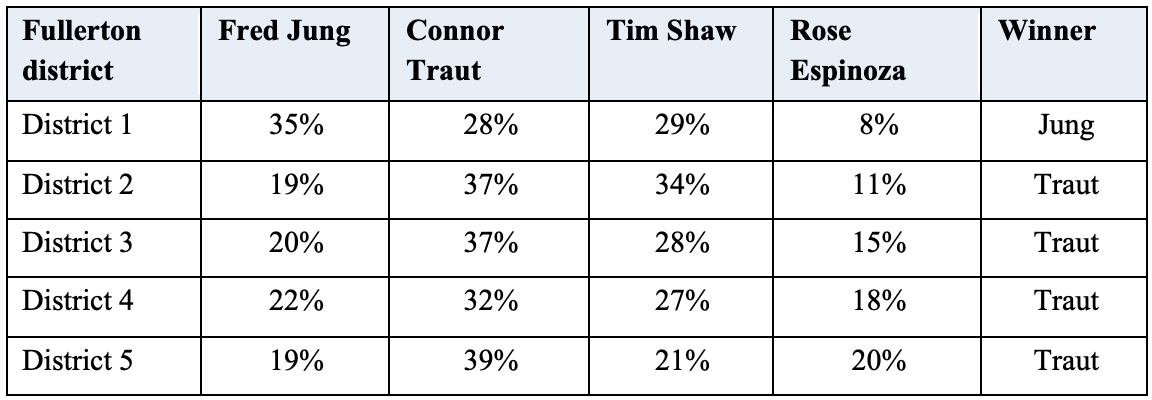
Source: Orange County Registrar of Voters, Statement of Vote, County Supervisor Fourth District—Grand Totals, Fullerton City Council district totals. Researched and aggregated by Professor Jody Agius Vallejo
As the table shows, Jung won only in D1—the district he represents on the City Council—and even there, it was hardly a sweep. He carried the district with only 35% of the vote. Nearly two-thirds of D1 voters who selected a candidate in the Supervisor race chose someone other than Jung. That result is especially notable because Jung constantly cites his 2024 City Council reelection—when he received approximately 72% of the vote in a two-candidate race—as evidence of strong support within his district. Where was that support when he ran for OC Supervisor?
If Jung’s 2024 victory represented a broad and durable personal coalition in D1, we would expect substantially more of that support to have followed him when he sought higher office as an OC Supervisor. The primary election results cannot tell us why individual voters made their choices. But the sharp difference between Jung’s 2024 and 2026 vote shares raises the possibility that support within his home district is waning as residents are learning more and more about his controversial governing record.
Overall, Jung lost every other Fullerton district by wide margins in the city where he has repeatedly served as mayor, coming in third in Districts 2 and 4, and last in District 5.
Fullerton does not elect its mayor directly and has historically followed a rotation intended to distribute the mayoral position fairly between council members. Jung has served as mayor for four of the last six years and mayor pro tem for one, but only by repeatedly departing from Fullerton’s mayoral rotation policy, a move supported by his voting bloc. He even nominated himself for mayor in 2024 after serving two years as mayor (2021 and 2022) and one year as mayor pro tem (2023). Jamie Valencia, a councilwoman in D4 and Jung’s mentee, nominated him in 2025. Jung’s pattern of monopolizing the mayorship has resulted in increasing public outcry among Fullertonians.
The title of mayor matters. Although Fullerton’s mayor does not possess independent executive authority, the position confers considerable status. The mayor presides over meetings, can place items on the council agenda without securing a second councilmember’s support, represents the city publicly, receives media attention, and meets with outside officials. To people unfamiliar with Fullerton’s council-manager system, a mayor may appear to be the city’s directly elected leader, which they are not.
But status is not the same thing as legitimacy.
Political power has several dimensions. Positional power comes from holding offices, influencing agendas, making appointments, and gaining access to important institutions. Electoral power rests on the demonstrated ability to mobilize voters across constituencies. The two can reinforce one another, but they are not interchangeable. A politician can accumulate titles, appointments, donors, and elite relationships without building a broad popular coalition.
Electoral power must be built from the bottom up through trust, responsiveness, competent governance, and sustained support from voters.
Jung’s record illustrates that distinction. His council position, voting bloc, and political alliances outside of Fullerton confer positional power by providing him access to the mayoral title and a network of board appointments at the county level. But when he attempted to convert that accumulated positional power into higher office as Supervisor, Fullerton voters rejected him.
That distinction matters because Jung did not run for Supervisor merely as an individual candidate. He used the Fullerton mayoral title—and his version of the governing record attached to it—as a principal credential for higher office. By asking voters to treat that record as evidence that he deserved greater power, he invited them to scrutinize both his performance and how he represented it. That required giving voters truthful information about his record in Fullerton on his candidate statement for OC Supervisor, where he claimed the title of Business Owner, claimed to have built nine parks, and also claimed to have balanced Fullerton’s budget.
That description did not survive a court challenge. Jan Flory, a retired attorney and former Fullerton mayor and councilmember — and a listed supporter of Connor Traut — petitioned to challenge Jung’s ballot designation and statement. In March 2026, Judge Kimberly Knill ruled in Orange County Superior Court that Jung’s “Business Owner” ballot designation was false based on the evidence presented and that portions of his candidate statement were misleading. The final statement replaced “Business Owner” with “Businessman” and required that Jung remove the false claims that he had opened nine new parks and balanced Fullerton’s budget. Those corrections reflect Jung’s actual poor record, even as he monopolized the mayorship.
Five months later, the budget claim looks worse still. In March 2026, city staff projected a $13.7 million deficit for fiscal year 2026–27 if Fullerton continued on its existing course. After staff identified millions of dollars in reductions, the remaining projected shortfall was approximately $3.8 million.
Jung and his voting bloc—consisting of Nick Dunlap (District 2) and Jamie Valencia (District 4)—adopted the most stringent budget cut options presented to the council on August 18, 2026. The new budget defunds six vacant police positions and the vacant fire marshal position, reduces library staffing, eliminates funding for library book purchases, and reduces graffiti-removal services, among other critical city services.
Ultimately, residents are being asked to absorb significant reductions to public safety, library resources, and community services because Jung and his voting bloc, who control council decisions, failed to address Fullerton’s financial troubles before it became a crisis.
As mayor, Jung also supported a 2025 policy prohibiting nongovernmental publications from being distributed at most city facilities. The policy removed access at City Hall for publications including the Fullerton Observer and Cal State Fullerton’s student-run Daily Titan, prompting First Amendment and censorship concerns and criticisms that the policy weakened public access to local reporting, thereby reducing transparency.
Critics also point to what they describe as a years-long pattern of decisions benefiting donors and political supporters, including below-market leases and sales of public property.
We do not know why voters rejected Jung so soundly. But the scale and geographic consistency of his loss in Fullerton, especially the fact that 65% of voters in D1 voted for someone else, remain politically meaningful. Jung should have enjoyed a substantial home-city advantage: name recognition, repeated mayoral visibility, an established political network outside of Fullerton, and a record voters could evaluate firsthand.
The results and his record at City Hall also help explain the current effort to recall Jung from the Fullerton City Council. District 1 residents have initiated the formal recall process, while a parallel effort is underway in District 4 against Jung’s mentee and ally, Councilmember Jamie Valencia. Recall organizers cite Fullerton’s budget deficit, declining public services, a lack of transparency, disregard for residents’ concerns, and a pattern of governance that has concentrated Jung’s political power while weakening public trust.
Ultimately, the June 2026 primary election exposed the limits of Jung’s political power. He accumulated titles, appointments, money, and institutional visibility, but he could not convert those advantages into a broad electoral coalition, even in his own District. Fullerton rendered its verdict, and the rest of Orange County confirmed it.
###
Share this:

Discover more from Fullerton Observer
Subscribe to get the latest posts sent to your email.
Categories: Election, Elections, Local Government, Local News


He won a plurality of votes in Fullerton’s District 1 in a four person race and he won his last council election with nearly three quarters of the vote. I’d say he still has significant support in Fullerton’s District 1, even if he lost the recent race for Supervisor. The author fails to mention that Jung ran as a political independent, not registered with a political party. Although local offices are non-partisan in CA, the reality is that major political parties provide support and endorsements that can be decisive in races. How else would Conor Traut, a little known council member from one of the smallest cities in North OC come out ahead? Well, let’s think…the author notes that this will be “first time since 2003, the Fourth District’s Supervisor will not be from Fullerton.” You know what it WON’T be? The first year since 2003 that a Fourth District Supervisor isn’t a white man. For all of the failures of his campaign, when it comes down to it it’s not hard to imagine that part of Fred Jung’s loss is due to his being a Korean American and not a European American, like the two candidates who made the runoff.
Matt, you have now posted this same missive on two other sites where my article appeared. Since you continue to repeat these claims publicly, I will post my response here as well so that the full exchange—and the facts—are part of the public record. n
I appreciate your comments and the opportunity to engage!
Yes, Jung won District 1 with 35% of the vote, but that share is not the broad mandate he repeatedly claims. Nearly two-thirds of District 1 voters who selected a candidate for supervisor chose one of his three opponents.
Party endorsements certainly mattered. Traut had the Democratic Party’s endorsement, while Shaw had the Republican Party’s. But Jung was not an institutionally isolated independent in any way. He was endorsed by the Lincoln Club, a conservative donor org; he entered the race with the largest campaign war chest; spent more than $128,000 during the opening months of 2026; and advertised support from police and fire unions. Party endorsements may explain part of his defeat across North OC, but they do not erase his dismal showing in Fullerton where voters knew him best and could evaluate his record firsthand.
I also disagree with your characterization of Connor Traut as an unknown council member. Traut is serving his second term as Buena Park’s mayor, had served on its City Council since 2018, previously spent four years as an elected school-board trustee, and held positions with the Orange County Fire Authority. He has also built an impressive coalition of labor, public-safety, environmental, and political organizations. His success reflects years of grassroots coalition-building, transparency, and trust, not a reliance on personal power.
Finally, as a sociologist who studies race, I find your final argument especially troubling. Racial bias is real but it cannot simply be inferred whenever a candidate of color loses to white candidates. Demonstrating that race shaped this outcome requires evidence. Invoking racism without such evidence turns racial identity into a shield against democratic accountability and implies that criticism of an Asian American politician is inherently racial. The public criticisms of Jung are grounded in years of evidence from his public actions and record at City Hall for all to see.
Thank you again for sharing your thoughts!!
He deserves it, and so much more. Fred Jung is dragging Fullerton down, he represents all that is wrong with modern american politicians. Self serving, corrupt, dishonest.. these are the traits that describe Fred Jung and the council at large.
Corruption comes in many forms, in this case its cronyism and favoritism.. lower leases for Bushala, not for Les Amis, going against Walk on Wilshire at the objection of the community and because a couple of “important” business owners (not all!) in that area wanted it, prioritizing repairs to the roads in his own neighborhood over areas of the community that dont support him, leaving our city a patchwork of potholes. Hiring a city manager who gets paid significantly more than the manager of New York (!!!) despite our budget shortfalls. Do we need to bring up the Union Pacific Park? The list goes on and on and on and on. Fred is consistently on the wrong side of every vote, consistently against the non-donating community, his actions speak louder than his words ever will.
And the result of all this? Cuts to city services and the loss of significant community cornerstones, just so Fred can keep scratching the back of his donors. Fred needs to be recalled, as does the council. The city manager needs to be fired and salary cut in half at least. We must take our city back from these corrupt politicians who are in it to only enrich and serve themselves and their donors. City Hall is a cesspool, at this point the state should probably step in and investigate Jung and his cronies. Fullerton deserves so much better, we deserve so much better.