
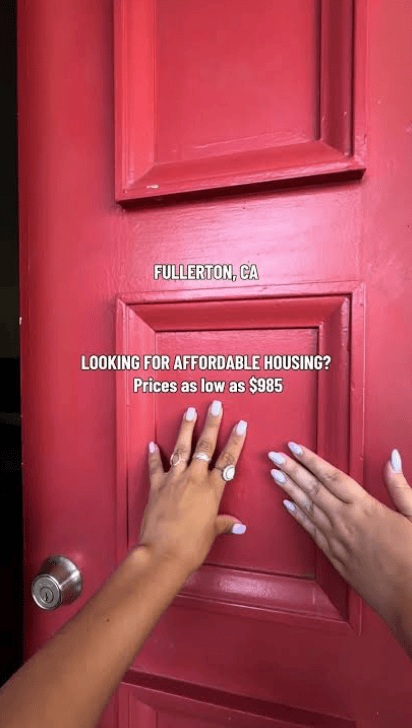
 A scam that has been working its way across the country has arrived in Fullerton’s rental market, and it is built for exactly the person who is most desperate to find a place: someone scrolling their phone at midnight, watching a clean walkthrough video of a one-bedroom near campus listed at half of what anything else costs.
The setup is simple. A TikTok account posts a video of an apartment, a room in a house, or a backyard ADU somewhere in Fullerton. The footage looks professional because it is professional — it was lifted from a real estate agent’s listing, a property management company’s marketing reel, or a Zillow page. The price is well under market. When someone comments or DMs, the person behind the account says the unit is in high demand and that a tour requires a completed application first. The application costs $50, $75, sometimes $100. It is described as nonrefundable, or sometimes as“refundable once you move in.” Payment goes through Zelle, Venmo, Cash App, or Apple Pay.
Then the account stops responding. Sometimes it disappears entirely and reappears the next day under a slightly different handle.
The unit was never for rent. Some of the addresses are real and some are invented.
Fullerton has the two ingredients this scam needs. Rents are high enough that a bargain looks like salvation, and there is a large, churning population of renters who are new to the process.
One-bedroom apartments in Fullerton have been averaging somewhere in the range of $2,100 to $2,400 a month, with citywide median rent across all unit types running roughly $2,400 to $2,800 depending on which tracker you consult. Against those numbers, a listing at $1,000 or $1,200 does not read as impossible. It reads as the lucky break everyone is hoping for.
 Add roughly 40,000 students at Cal State Fullerton, thousands of whom look for off-campus housing between May and July every year, plus international students unfamiliar with California rental norms, plus a genuine boom in accessory dwelling units across Orange County that has made “converted garage studio” a plausible listing category. The result is a large group of people searching hard, moving fast, and without a mental baseline for what a normal rental application looks like.
Scammers do not need to be sophisticated to profit here. They need volume. Post fifty fake listings, collect $75 from a handful of people on each, and disappear.
This is the part worth understanding, because it turns a vague bad feeling into a concrete rule you can apply.
California Civil Code § 1950.6 governs rental application screening fees, and it is unusually specific. Three provisions matter here:
• A landlord cannot charge an application screening fee when they know, or should know, that no unit is available or will be available within a reasonable time. Read that again in the context of a fake listing. The fee itself is the crime, not just the bait.
• The fee is capped. The statutory base is $30 per applicant, adjusted annually for inflation. There is no single official figure published by a state agency, but 2026 estimates cluster in the mid-to-high $60s — Berkeley’s Rent Board, one of the few local bodies that publishes a number, lists $68.96 for 2026. A $100 “pre-screening fee” exceeds any defensible reading of the cap.
• Unused portions must be refunded, and you are entitled to an itemized receipt. A fee can only cover the landlord’s actual out-of-pocket screening costs plus reasonable processing time. It is not a revenue stream. Which means a fee advertised as flatly “nonrefundable” is, at minimum, being described in a way a compliant California landlord would not describe it.
 So when someone on TikTok demands $100 nonrefundable through Cash App before you can see the unit, they are not just being pushy. They are describing a transaction that is illegal in California even if the apartment existed.
Fullerton renters are not being singled out. Reporting over the past year has documented the identical playbook in Milwaukee, where a fake page charged $52 before anyone could tour; in Atlanta, where a TikTok account impersonated at least two licensed agents and pushed “no credit check” subleases with a $100 pre-screening fee; in South Jersey, where a single account posted cloned listings across multiple towns; and in Louisiana, where a broker found a $325,000 home she had listed for sale being advertised on TikTok as an $1,100 rental.
The Federal Trade Commission has tracked roughly 65,000 rental scam reports between 2020 and 2025, totaling around $65 million in losses. A December 2025 FTC data spotlight found that about half of reported rental scams in the preceding year began with a fake ad on social media. Video platforms are simply the newest surface.
Red flags, in rough order of reliability
- Payment demanded before an in-person tour. This is the single most reliable signal. Legitimate Fullerton landlords show units.
- Rent far below comparable listings. If everything similar nearby is $2,200 and this one is $1,100, the gap is the product being sold to you.
- Payment by Zelle, Venmo, Cash App, or Apple Pay. These are chosen because they are effectively irreversible.
- Communication that never leaves the app. No company email domain, no office address, no phone call.
- Urgency. Other applicants, offer expiring tonight, someone else is ready to pay.
- A “nonrefundable” fee, or one above roughly $65.
- Excuses about why nobody can meet you. The owner is traveling, the property manager is out of state, just drive by and look in the windows.
- A request for your Social Security number early on. A landlord does not need it to schedule a showing.
Verify before you pay
Reverse image search the video stills, or search the address directly. If the property comes back as listed for sale, or listed for rent at a different price by a different party, you have your answer.
Look up the address in the Orange County Assessor’s records to see who actually owns it, then contact that person independently rather than through the number in the TikTok bio. If the person claims to be a licensed agent, check the license at the California Department of Real Estate’s public lookup and call the brokerage’s published number, not one they gave you.
Drive by. Fullerton is small. If the listing is a converted garage or a room in a house, standing in front of it for two minutes will tell you a great deal.
Pay by credit card if you pay at all. Credit cards carry chargeback rights that peer-to-peer transfers do not.
If you already paid
Contact your bank or payment app immediately and ask to reverse or dispute the transfer. Success is not guaranteed with Zelle or Cash App, but speed matters and some claims are recoverable.
File a report with the Fullerton Police Department at (714) 738-6700, or through the department’s online reporting system, which accepts financial crime and fraud reports for incidents that occurred within city limits. CSUF students can also contact University Police at (657) 278-2515.
Report to the FTC at ReportFraud.ftc.gov and to the FBI’s Internet Crime Complaint Center at ic3.gov. These reports are how patterns get identified across jurisdictions, which matters for a scam that is deliberately run across many cities at once.
Report the account to TikTok. Platforms have removed these accounts when they are flagged, though near-identical replacements often surface quickly.
If you own or manage property in Fullerton, it is worth periodically searching your own address on TikTok. Owners have discovered their homes advertised as rentals they never listed, and have had strangers show up at the door expecting a showing.
Other Resources from the City of Fullerton
- Internet Crime Complaint Center, a partnership between the Federal Bureau of Investigation (FBI), the National White Collar Crime Center (NW3C), and the Bureau of Justice Assistance (BJA)
- Common Scams
- On Guard Online (federal government online safety website)
This article is general consumer information, not legal advice. If you have lost a significant amount of money, consider consulting an attorney or contacting a local tenant assistance organization or Fullerton Police Department.
Share this:

Discover more from Fullerton Observer
Subscribe to get the latest posts sent to your email.
Categories: Education, Local News


Thank you M and friend for bringing this scam to the attention of the Fullerton Observer.