

Approximately 100 volunteers, including students, staff and campus leaders – including university President Dr. Ronald S. Rochon – converged in the Second Harvest Food Bank of Orange County’s Distribution Center to help Second Harvest provide food for the 453,271 OC residents it serves monthly on average. Photo by Brittany Aquino
On National Food Bank Day, September 4, approximately 100 Cal State Fullerton students, staff and campus leaders rolled up their sleeves at Second Harvest Food Bank of Orange County for a special Hunger Action Month volunteer shift. President Dr. Ronald S. Rochon joined the group, along with mascot Tuffy the Titan, working alongside students on the warehouse floor.
Volunteers spent the shift preparing produce for distribution across Orange County — sorting, inspecting and packing fruits and vegetables bound for the food bank’s network of community partners. It is unglamorous work, done at speed, and it is the step that stands between a pallet of donated produce and a family’s dinner table.

Cal State Fullerton students sort fresh produce to assist the 1 in 8 Orange County residents experiencing food insecurity. Those seeking food assistance often visit a pantry more than once per month.
The scale of the problem in Orange County is easy to overlook in a region known for its affluence. One in eight residents and one in six children are currently experiencing food insecurity, meaning they lack reliable access to enough affordable, nutritious food.
Demand has continued to climb. Second Harvest now serves an average of 453,271* community members each month, distributing food through pantries, mobile distributions, schools and partner agencies throughout the county.
For Cal State Fullerton, the issue is not only a community concern — it is a campus one.
A recent Cal State Fullerton/UCLA study found that 46% of CSUF students experienced some level of food insecurity. Conducted with the UCLA Center for Health Policy Research and supported by the ECMC Foundation, the study surveyed a 25% stratified random sample representative of the CSUF student body during spring 2024. A total of 771 students completed the survey, which used the validated USDA household food security measure.
The 46% figure splits evenly into two halves. Roughly 23% of students were classified as low food secure, meaning they cut back on the quality, variety or desirability of what they ate. Another 23% were very low food secure — they changed their eating patterns outright and reduced how much they ate. A further 19% were marginally food secure: anxious about having enough food, but not yet altering their diet. Only about 35% of students reported high food security, with no difficulty accessing food at all.
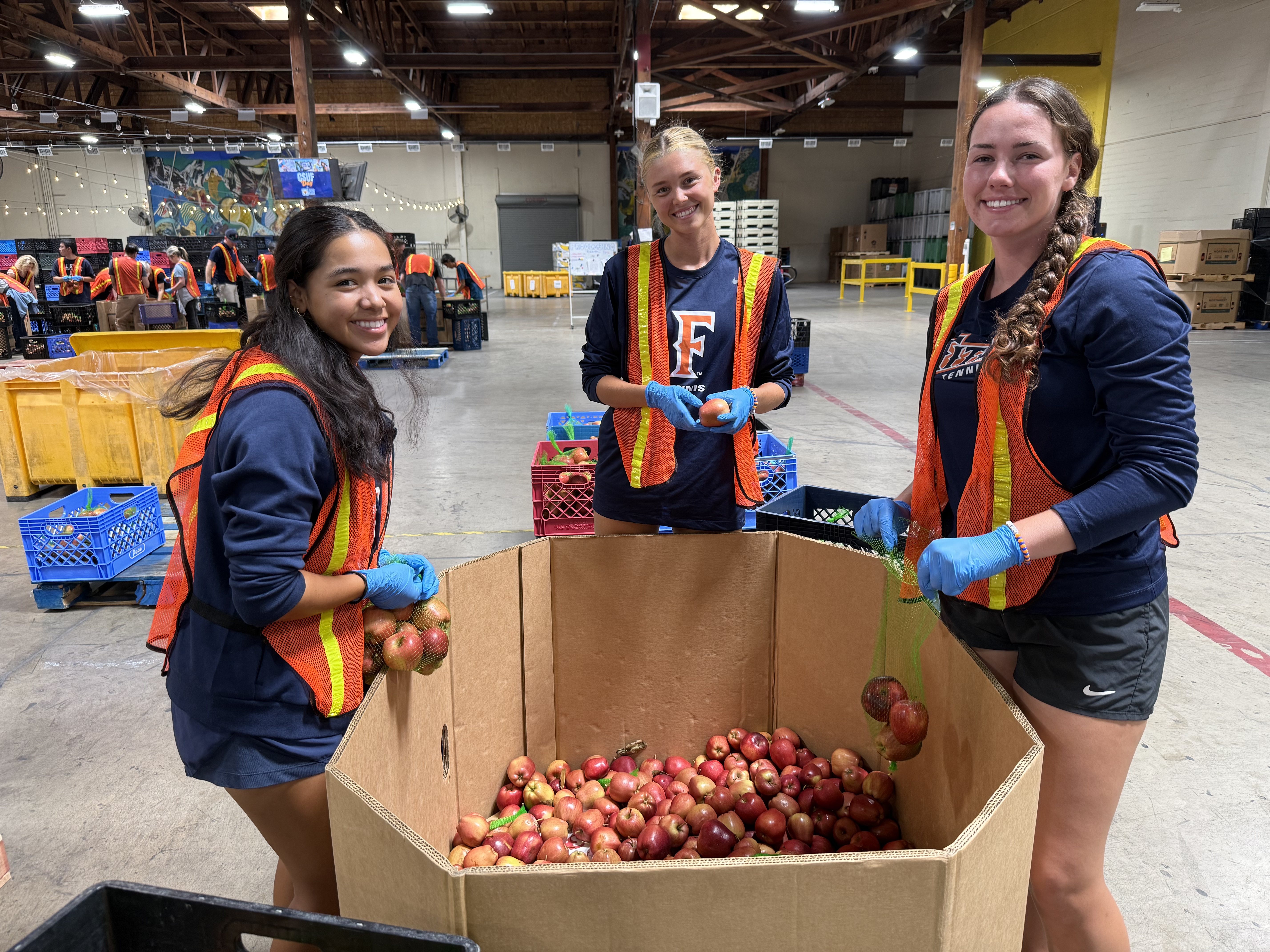
Cal State Fullerton staff Tisha Domingo and Gabriel Dima-Smith participate in the volunteer activities, sorting produce for the community.
Put another way: in a class of 30 Titans, roughly 14 are navigating uncertainty about their next meal while also managing coursework, commutes, jobs and, for many, family responsibilities.
Rates were elevated across every racial and ethnic group measured, ranging from 33% among Middle Eastern and North African students to 53% among non-Hispanic Black students, with Hispanic/Latinx students at 47% and students of other races at 51%. Those differences were not statistically significant.
The sharper divides showed up elsewhere. Seventy percent of students who had been in the foster system reported food insecurity, as did 61% of students with disabilities and 61% of international students. First-generation college students reported a rate of 50%, compared with 39% of students whose parents attended college. The differences for students with disabilities and first-generation students were statistically significant; the foster youth and international student findings rest on small samples and should be read with that caveat.
Perhaps the study’s most actionable finding is not how many students go hungry, but how many go hungry within reach of help. Close to one in five students did not know the campus food pantry existed. More than half of food-insecure students had heard of available resources but were not using them. Among food-insecure students familiar with the ASI Food Pantry who did not use it, 46% said they did not know how, 35% said they did not have time, and 32% said they felt embarrassed about accessing it.
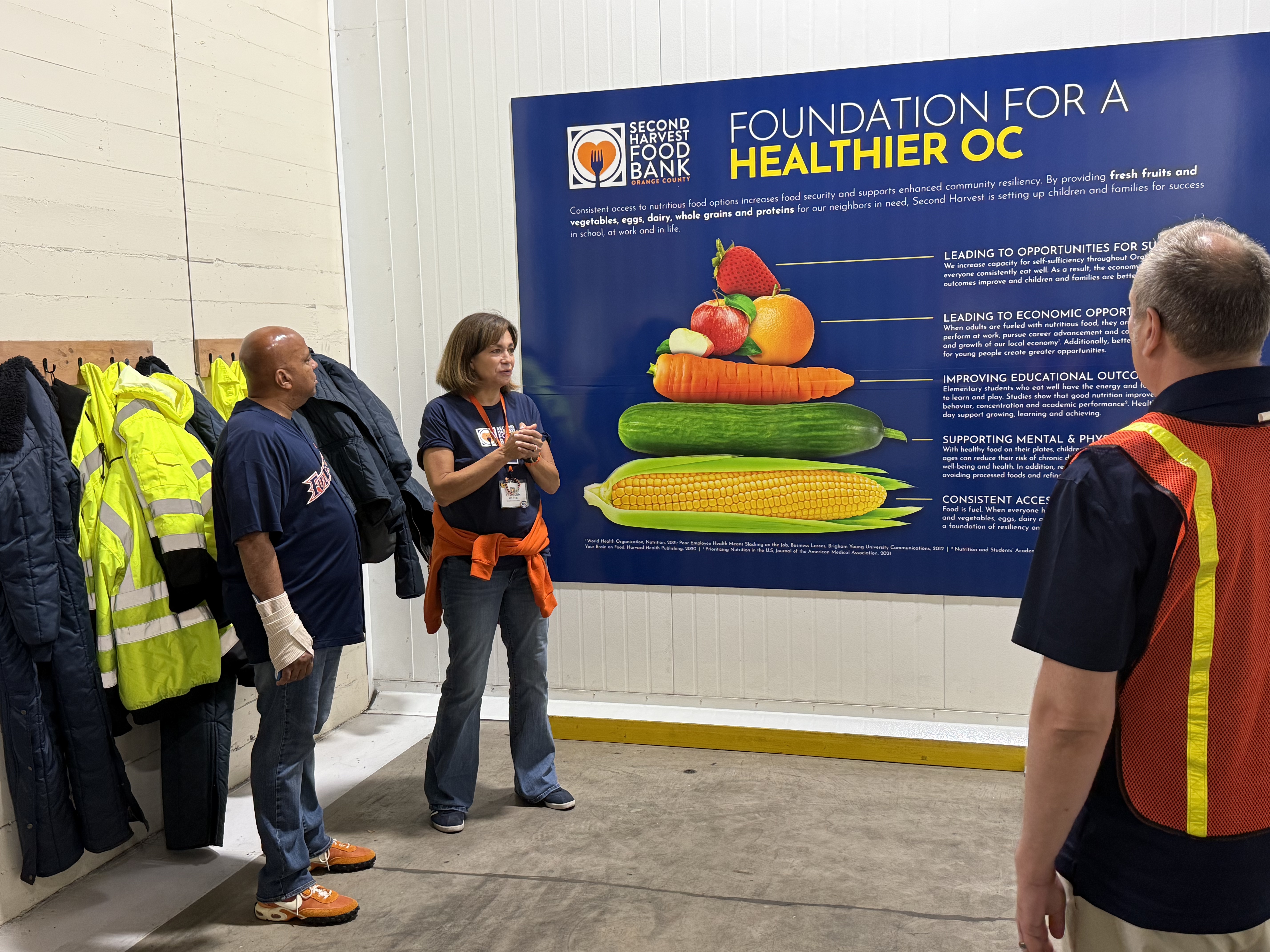
Second Harvest Food Bank of Orange County CEO and Cal State Fullerton Alum Claudia Bonilla Keller describes the Food Bank’s perspective on the importance of providing fresh, nutritious foods to the community with Cal State Fullerton President Dr. Ronald S. Rochon.
The pattern repeated with CalFresh, the federal nutrition benefit known nationally as SNAP. Among food-insecure students who knew about the program but did not use it, 40% believed they were ineligible and 30% did not know how to apply. For the campus service that helps students complete CalFresh applications, 28% did not know how to access it and22% assumed they did not qualify.
Together, those numbers point to awareness, navigation and stigma as the obstacles standing between students and food that is already set aside for them.
That last finding is what gave the September shift a second layer of meaning. When nearly a third of food-insecure students say embarrassment keeps them from a campus pantry, a university president and a mascot sorting produce in public does something beyond the day’s output: it puts hunger relief in the open, as ordinary community work rather than a private difficulty.
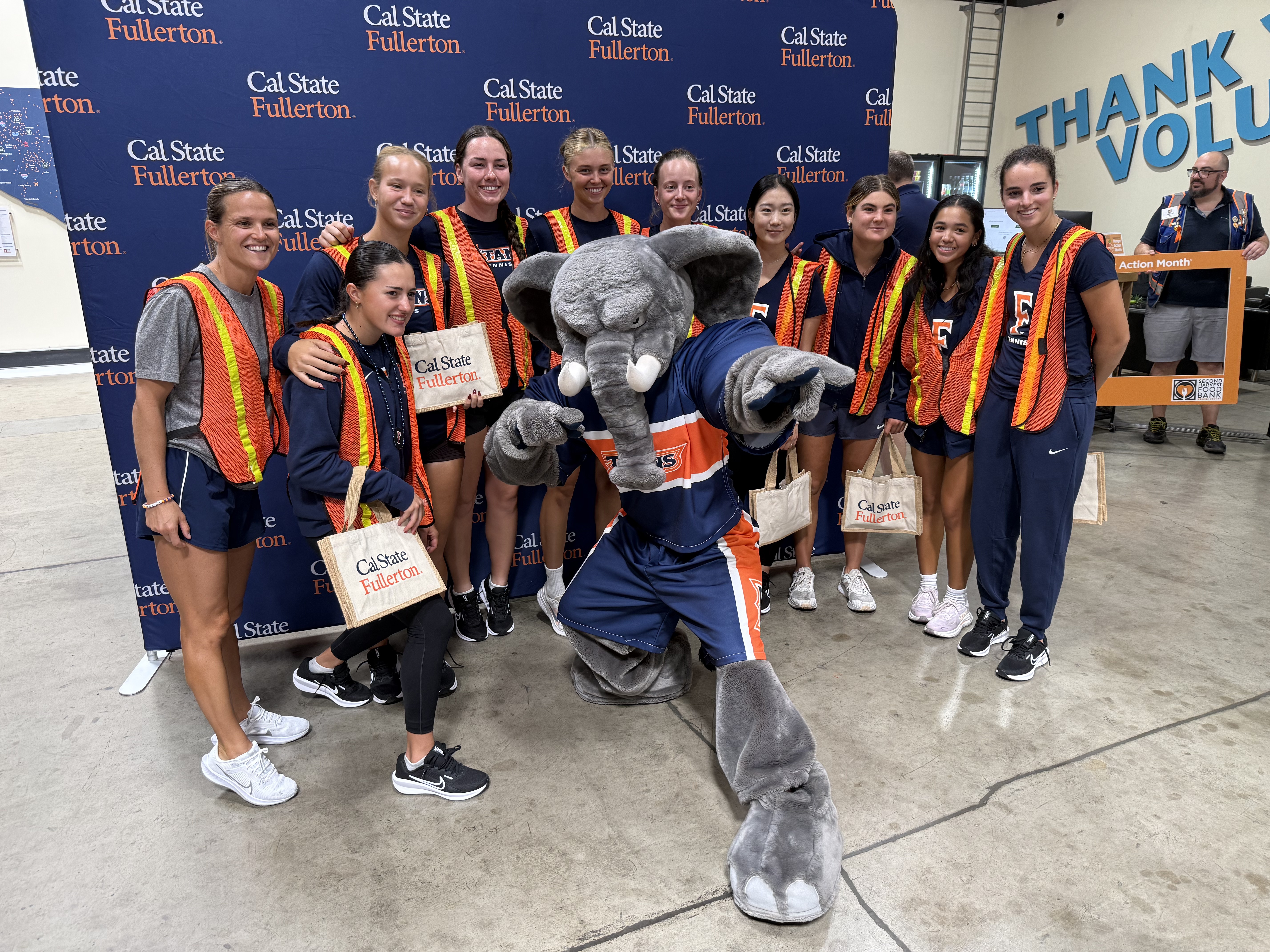
Tuffy the Titan and members of the Cal State Fullerton Women’s Tennis team
Hunger Action Month, observed each September nationally, is built around exactly this kind of visible participation.
CSUF maintains year-round support as well. The Associated Students Food Pantry in the Titan Student Union provides groceries and fresh produce to enrolled students, and Tuffy’s Basic Needs Services Center connects students to food assistance, emergency grant funding, CalFresh application help and other resources. No hardship documentation is required to visit the pantry.
Second Harvest Food Bank of Orange County accepts volunteers year-round, with shifts available for individuals and groups.
*Monthly average of community members served, per Second Harvest Food Bank of Orange County.
Study citation: Nobari TZ, Babey S, Wolstein J, Espericueta V, Scheitler AJ. Food insecurity among CSUF students: Findings from the UCLA CSUF study. UCLA Center for Health Policy Research, 2024.
Share this:

Discover more from Fullerton Observer
Subscribe to get the latest posts sent to your email.
Categories: Education, Local Events, Local News


